
Plumbing Notes: Swifter Injections
the Fed is priced to pull the trigger sooner rather than later
Welcome to Plumbing Notes #5. This is the first of a new type of post. As stated in the chat, if a chat update (like this) grows too large, we’ll post it as an article. Let’s dive in…
Money Market Commentary: Swifter Injections
Reserves may arrive sooner than expected. The market has priced out delayed liquidity injections from the Fed, with an earlier balance-sheet expansion baked into markets. Trading desks now expect the Fed’s RMOs (reserve management operations) — where it buys bills with newly minted reserves to maintain ample liquidity1 — to begin closer to January.
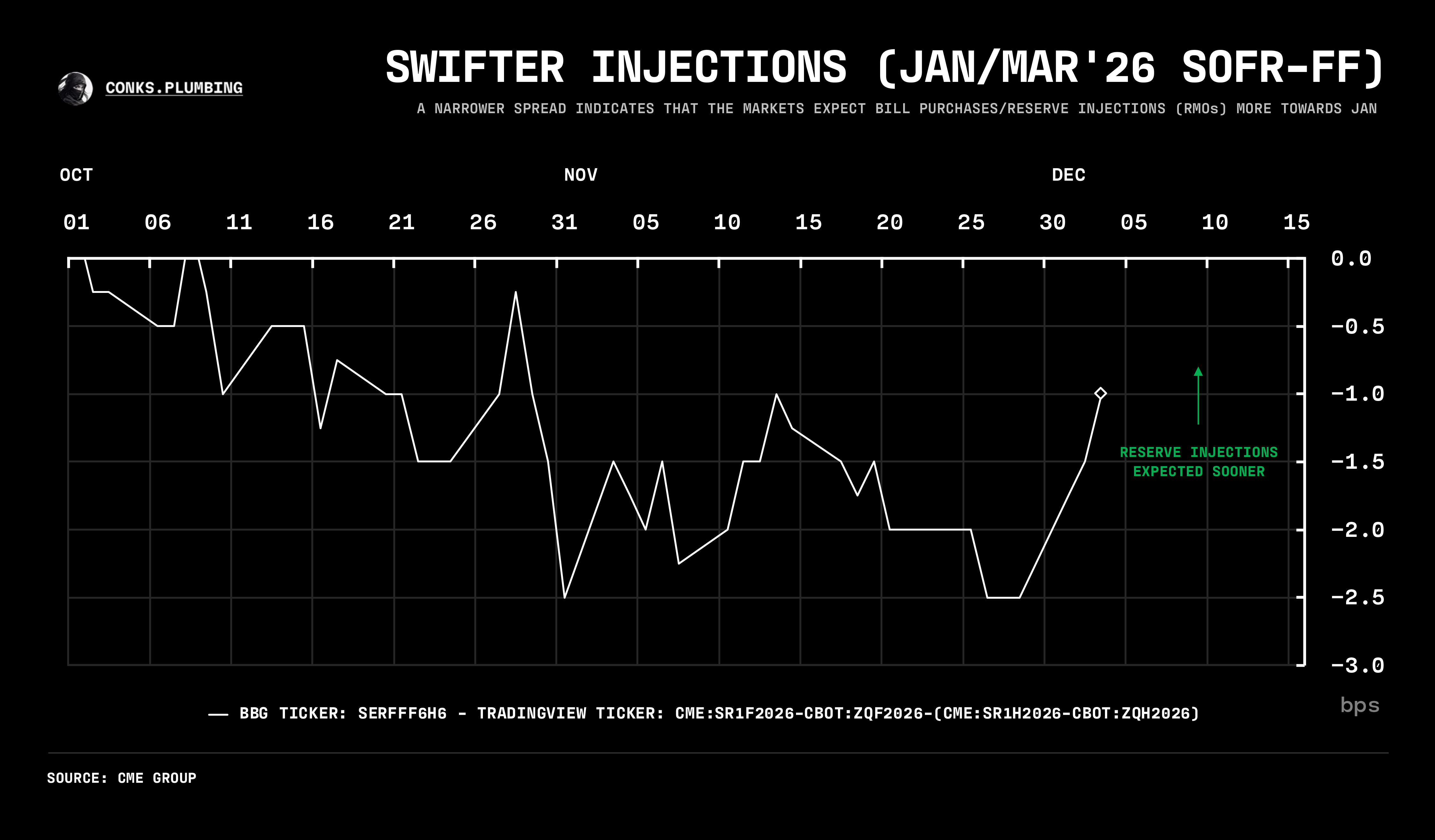
This is observable via relative SOFR-FF (basis) spreads, which provide a contrast of dollar funding conditions at various points in time. Since SOFR-FF spreads rise (or grow less negative) when the market believes the SOFR-FF basis will narrow in one month compared to another, the latest market moves show traders are betting on earlier RMOs. They could be pricing in a multitude of catalysts. Nevertheless, SOFR-FF in Jan’26 tightening compared to March ‘262 likely suggests participants desire a swifter end to tighter money markets.
Accordingly, the market has been pricing in a slightly less stormy year-end, even though bank balance sheets are set to tighten significantly. Another pivotal spread between December and January (denoted by Dec’25/Jan’26 SOFR-FF3) has priced in a softer finale, now expecting funding conditions to receive only 1bp of relative easing in January.
As for Dec SOFR-FF, the year-end basis market tends to overprice tightness in advance and then sell off as the year concludes. Indeed, after reaching 13.5bps, Dec SOFR-FF is now approaching single digits.
Until RMOs go into effect, only one part of the basis, i.e. SOFR, will matter. The overnight Fed Funds rate (o/n FF) that determines EFFR should remain elevated but likely flatline once again. o/n FF sits only 1bp below IORB and should hover there, as FHLBs (Federal Home Loan Banks) will always want to lend reserves. FHLBs can’t earn interest on their reserve balances at the Fed and thus must earn a return on a non-interest-bearing asset to avoid negative carry. Foreign banks, meanwhile, are only willing to trade and engage in IORB arbitrage (i.e. borrow in Fed Funds and park reserves at the Fed to accumulate IORB) when borrowing at or below 3.89%, the latest EFFR print.
SOFR, meanwhile, will be exposed to the ongoing balance sheet winter, facing only a few tailwinds. With the U.S. Treasury fully satiated, net bill issuance has peaked, yet bill paydowns4 will last only a single month. December precedes another giant ramp-up in bills through Q1 ‘26, as the Treasury’s war on duration will swap hundreds of billions in coupons (i.e. notes and bonds) for ultra-short-term sovereign debt by 2027.
Still, bank balance sheets will be in much better shape to absorb a flood of short-term issuance, with winter concluding post-year-end. Now that November month-end has passed, o/n rates should briefly return to their regular sweet spot between SRFR (the SRF’s minimum bid) and IORB. But it’s the calm before the storm. Much to Conks’ dismay, the balance sheet winter is still in session. Some banks now project the Fed will signal its intention to expand its balance sheet as early as the Dec FOMC meeting, with RMOs beginning sometime in late January. Nonetheless, that won’t stop any immediate stormy weather, with no assistance likely to emerge at the incoming FOMC presser. The Triparty-Fed Spread (TGCR-SRFR) shows dealers are only paying a truly irrational rate on month-ends, when logic is known to fly out the window. In an era of excess collateral, rate spikes above the SRF are now commonplace at both mid-month and month-end — at least until liquidity injections begin.
Despite the most innocent repo market rates rising sharply above the Fed’s SRF, which prompted Chair Powell to call for an end to QT, the Fed will likely ignore it when considering further intervention. Instead, its “plumbing soft landing” has been achieved. Lowering IORB and SRF to contain rates would now be overkill, given that balance sheet run-off is over, net bill issuance is set to decline, and RMOs could begin in only a month’s time. As a Dec FOMC start for reserve injections remains far-fetched, funding markets should stay tight over the year-end turn. The balance-sheet winter’s harshest phase won’t be as forgiving as the latest money market moves expect.
If you enjoyed this, hit the ♡ button below the footnotes to let us know (it helps us grow) and share a link/message on social media. Comments are also encouraged. Remember, nothing in the piece is financial advice. If you act on anything, you agree to this disclaimer. Thanks for being a Conks Subscriber!
Fed balance sheet: [↑bills|↑reserves]
observable via BBG: SERFFF6H6 or TradingView: CME:SR1F2026-CBOT:ZQF2026-(CME:SR1H2026-CBOT:ZQH2026)
observable via BBG: SERFFZ5F6 - TradingView: CME:SR1Z2025-CBOT:ZQZ2025-(CME:SR1F2026-CBOT:ZQF2026)
i.e. net negative supply from maturing bills


Great post thanks! This flew over my head as usual. What’s the implication of this for equities into year end and in Jan? Santa Rally yes or no or bumpy ? Thanks!
Great post, thanks! I really like the z5f6 spread to visualize the year-end turn effect, and the f6h6 for the sooner than later fed liquidity injection.
One question - " December precedes another giant ramp-up in bills through Q1 ‘26, as the Treasury’s war on duration will swap hundreds of billions in coupons (i.e. notes and bonds) for ultra-short-term sovereign debt by 2027. " Is this a prediction or is that outlined in their qra or some other announcements please?