
Plumbing Notes: The Repo Fortification
the Fed's attempt to strengthen its fragile "upper jaw"
Welcome to Plumbing Notes #3. The full rework of the chartbook is complete and available below — including a monitor for the global dollar rate hierarchy. Major (pending) works: an infographic deck on the modern Eurodollar system [███▒%], a detailed look at the Fed’s Great Rebalancing [█▒▒▒%], and a new central bank target rate [███▒%]. But first, the mechanics behind a defective Fed facility…
Money Market Commentary: The Repo Fortification
The Fed’s upper jaw, the upper boundary of its target range, remains defective. The climax of the excess cash era1 has shifted the floor in o/n (overnight) rates above the Fed’s minimum bid (SRFR) at its standing repo facility (SRF), prompting hundreds of billions in repo trades to print outside the U.S. central bank’s target range. An o/n repo facility should enable leaders to enforce a ceiling by broadcasting the cheapest rate at which primary dealers and banks can increase their cash balances. On the surface, it appears a “risk-free” arbitrage exists, where money dealers can borrow at a much cheaper Fed rate (at times, around 20bps below their usual private counterparties) to bridge market imbalances. Beneath, however, numerous covert forces are preventing dealers from tapping Fed liquidity, producing an active yet impaired upper jaw. With repo rates threatening to again breach the Fed’s perimeters and drive spillovers into other markets during the next Covid-style event, a Repo Fortification is looming.
During mid-November, New York Fed President Williams convened with the heads of primary dealers2 at the annual U.S. Treasury Market Conference. The meeting took place not to resolve — presently nonexistent3 — liquidity issues but to remind key dealer banks they could tap cash via the SRF freely without stigma: the fear that other banks may conclude you’re in trouble upon borrowing Fed liquidity. SRF take-up (i.e. usage) appears to be worse than it was half a decade ago, even before the facility became official4. Much like the Fed’s leaky lower boundary (the bottom of its target range), the SRF has failed to contain money market rates, which officials now consider to be routine on month-ends. Rather than forming an immaculate ceiling, the Fed has come to admit that its repo counterparties won’t tap the facility en masse, despite vastly cheaper rates. Lackluster usage, even with persistent nudges from officials, reveals stigma has not only endured but proliferated.
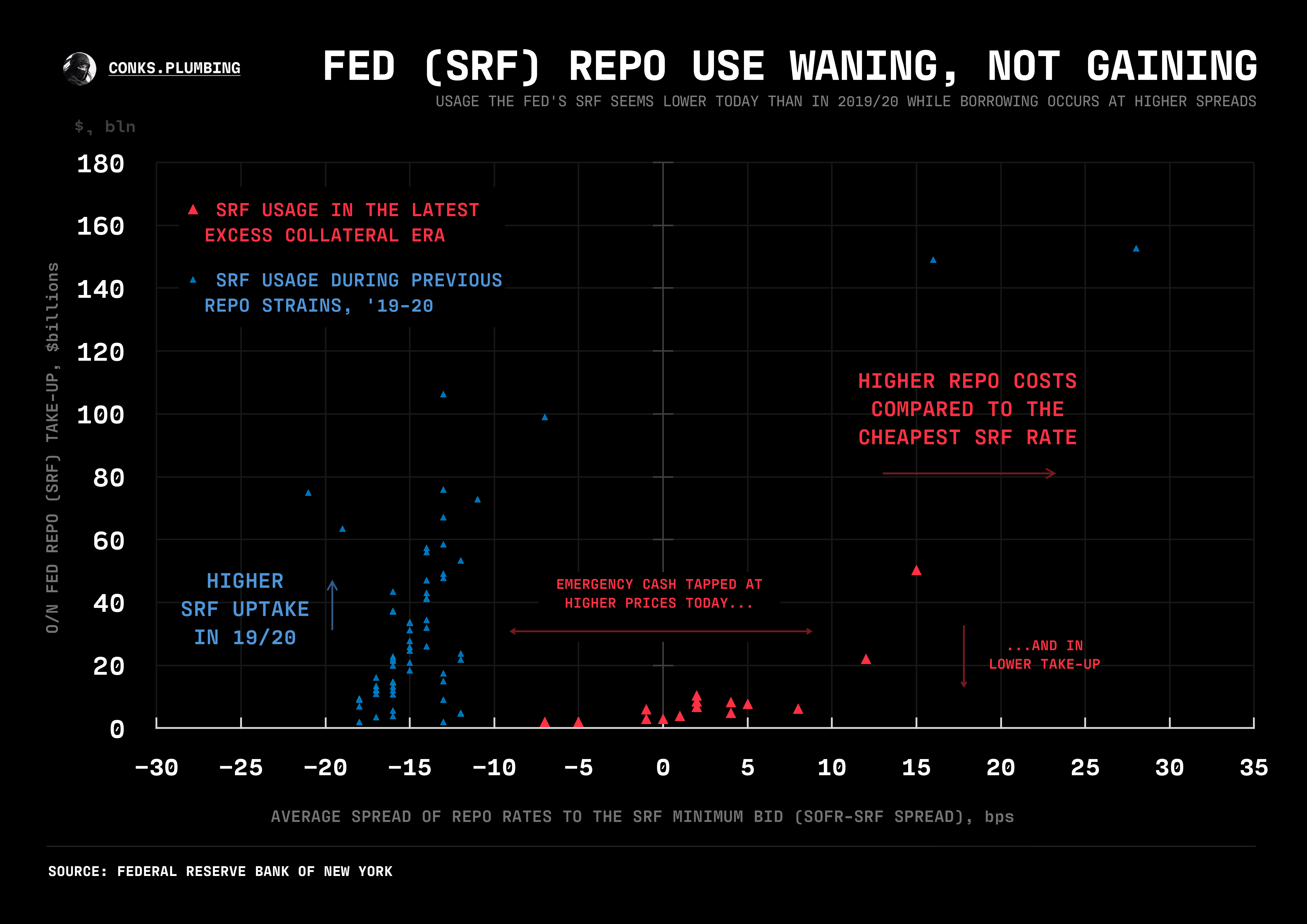
Monetary leaders are already losing the battle to persuade prominent market makers to use the SRF in size. But officials must also repair other defects with the current repo backstop. Stigma is only one of numerous obstacles preventing truly seamless access to central bank cash.
With frictions persisting, damage control is now in full effect. Central bank leaders, since late last year, could no longer sit back and watch major repo benchmarks casually breach their upper limits. In December 2024, reacting to a possible year-end storm in funding markets, officials deployed their first profound fortification in the post-SRF era. “Morning Fed repos” enabled primary dealers and banks to borrow cash at dawn via the SRF, partly fixing the facility's second-largest defect: timing.
Before early SRF auctions existed, dealers were exposed to interest rate risk when lending cash in the morning and then covering that outflow5 by borrowing from the Fed in the afternoon. Repo desks subsequently faced a “grueling” wait for the SRF to open at 1:15pm, potentially incurring a loss from lending in the morning at a lower rate than they would eventually borrow at from the Fed. Now that morning Fed repos are in effect, dealers have grown less exposed to negative carry6. Early operations provide liquidity shortly after the main repo trading hours of 7am to 8:30am — during which ~70% of trading occurs, with SRF trades booked and settled by 9am.
Although effective, morning auctions are merely painting over the cracks in the SRF. Fed leaders, aware of such gaps, must act sooner rather than later. The first step monetary leaders may take is to fix the “easiest” defects, outside of stigma, the first being that balance sheet costs arise even when transacting with the Fed. Since using the SRF requires tapping central bank liquidity and trading with another counterparty to bridge market imbalances, dealers can’t “net” such trades, and consequently require capital to supply emergency cash. Moreover, the rate to borrow from the SRF may have zero premium attached7, yet the Fed applies haircuts to the collateral — that primary dealers and banks must pledge — to protect itself from losses. Given that these can reach 0% in private markets, some bank traders have reported that relatively large haircuts have discouraged SRF borrowing.
Ultimately, these conflicts have pushed the Fed’s true repo ceiling well above SRFR, as dealer banks need to charge spreads as wide as 25bps over the top of the target range to make SRF trades worthwhile — and, more importantly, provide hedge funds with leverage to enter trades that fuel a well-oiled market.
Some frictions will resolve as other regulatory evolutions take shape. Balance-sheet costs, for instance, will decline over time as sponsored repo grows, allowing more hedge funds to centrally clear their trades via the FICC — the sole central counterparty (CCP) in repo markets — and thus enabling dealers to distribute Fed cash without raising further capital.

The next phase will involve a centrally cleared Fed itself, via the FICC and perhaps a few other competing CCPs standing in between the U.S. central bank and its SRF counterparties. A centrally cleared SRF will enable anonymity, reducing (some) anxiety of using emergency facilities. Primary dealers will also gain an emergency source of balance sheet when approaching the SRF, lowering the spread at which arbitrage trades, funded by Fed repos, become attractive.
Other frictions, meanwhile, will require a more active approach to clear. The Fed could deploy what Conks considers to be the central bank’s secret weapon. As of now, the SRF offers only overnight terms, where trades unwind the following day. Term repos, though, which unwind after more than the usual o/n period, finance a large share of basis trades, a market that bears wider, more costly bid-ask spreads than the o/n segment. Accordingly, “term Fed repos” would better enable dealers to intermediate emergency cash to hedge funds and to lock in funding over stormy periods, like the coming year-end “turn”.
Nevertheless, after fixing numerous defects, stigma persists. The Fed has entered a — perhaps slow — race against time, not to eliminate, but reduce “SRF anxieties” before the next money market storm emerges. Despair has set in sufficiently that monetary leaders have begun to act. The Fed will likely initiate a plan to centrally clear SRF trades sooner rather than later, presumably by Q2 ‘26. Implementation won’t prove easy and should take at least one or two years. The process may accelerate if officials elect a secured benchmark (SOFR or TGCR) as EFFR’s (i.e. the Fed Funds market's) successor to become the new Fed target rate. Either way, dealers’ “psychological plumbing” must be altered to fix their aversion to borrowing via Fed repos, which, only on the surface, allows seamless convertibility between USTs and reserves. To truly eliminate stigma, the Fed would have to “become one” with private counterparties by offering a round-the-clock auction. Even then, internal Fed investigations tested setting the rate on central bank cash to zero at the Discount Window — a facility that possesses an even greater boogeyman — and found the dread of using central bank facilities still persisted.
Since it’s trying to stick to its latest policy of intervening less (by intervening beforehand!), officials will never consider such a facility. Their ideal vision of a seamless SRF will thus fail to materialize. Instead, active Fed alchemy shall prevail. From mid-October, the combo of reserve drain and demand for leverage has reached a point where o/n rates have drifted casually outside the target range, forcing the Fed’s hand. Plumbing has begun to override the macro. With waning interbank balances and banks’ repo lending (see chart below) reaching its limit, permanent open market operations (POMOs) involving bill purchases that inject reserves are almost inbound8. Further intervention to nudge money market rates back within the target band, in the form of lowering SRFR (the SRF’s minimum bid) or IORB (the rate the Fed pays on banks’ reserve balances) or both, may follow9.
Whether cuts to these Fed-administered rates will prove bullish or bearish for the SOFR-FF basis (SERFF) depends on the scenario. If the Fed is trying to contain another significant rate spike, SOFR-FF should compress more than widen — i.e. SOFR falls further than o/n Fed Funds (FF). In calmer waters, there’s no clear answer. SOFR and EFFR may fall in tandem.
At the same time, regardless of monetary leaders’ best efforts, stigma can’t be lowered with a simple lever. To defeat the anxiety surrounding its defective emergency backstops, the Fed requires neither a meeting nor a technical adjustment, but at this stage, a plumbing miracle.
More Plumbing Notes
Join the Conks feed (chat):
In today’s Pro, the mechanics behind softer month-end spikes, color on the morning repo rush, why afternoon SRF auctions aren’t dead, and more…
Chartbook (3rd December 2025)
Changelog: major revamp of the chartbook
WIP: STIR monitor/Treasury monitor to accompany these updates
If you act on anything provided in this newsletter, you agree to the terms in this disclaimer. Everything in this newsletter is for educational and entertainment purposes only and NOT investment advice. Nothing in this newsletter is an offer to sell or to buy any security. The author is not responsible for any financial loss you may incur by acting on any information provided in this newsletter. Before making any investment decisions, talk to a financial advisor.
EFFR, OBFR, SOFR, TGCR, and BGCR are subject to the Terms of Use posted at newyorkfed.org. The New York Fed is not responsible for publication of tri-party data from the Bank of New York Mellon (BNYM) or GCF Repo/Delivery-versus-Payment (DVP) repo data via DTCC Solutions LLC (“Solutions”), an affiliate of The Depository Trust & Clearing Corporation, & OFR, does not sanction or endorse any particular republication, and has no liability for your use.
less cash seeking more collateral pushes up money market rates
now 25, not 24 primary dealers, with the recent addition of SMBC Nikko
Conks found only one or two accurate interpretations on X (formerly Twitter) of this meeting. as for liquidity issues, markets are simply clearing at rates above the SRF
hence “standing"
simultaneously hedging and creating a matched book
dealers barely take outright long positions and instead focus on capturing the juiciest spreads
there’s no penalty spread, such as when the Fed charged banks +50bps above OIS to borrow from its FX swap lines
but it is unlikely given the reasons laid out in the Fed’s Reckoning. why lower IORB and SRF when you can start injecting liquidity via RMOs (or simply announce you’re going to do so)


Hate when frictions and stigmas persist. RepoFortification worse than RePocalypse? Never had much faith in plumbing miracles. You?