
Plumbing Notes: Repo 101
a concise primer on repo market lingo & mechanics
Recently, we published a “mega-infographic” that unveiled the plumbing of the repo market in detail.
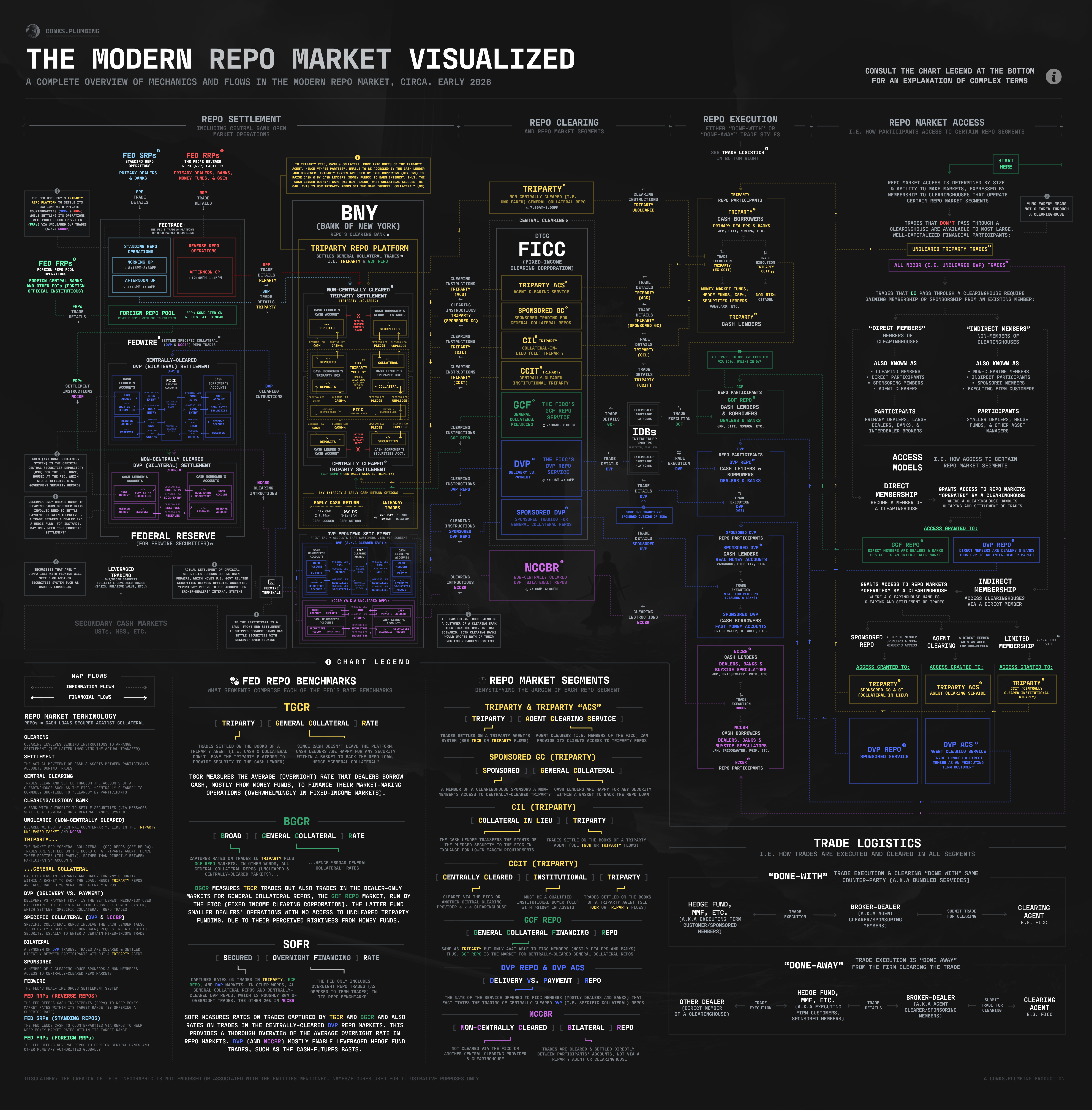
Given the amount of information required to demonstrate the complete flows of a repo trade, the graphic is tough to navigate without a PDF version. Subsequently, we’re providing one for all readers below.
Still, even with complete visuals, a written explanation is needed to comprehend such an intricate ecosystem. Welcome to a Repo 101: a brief primer that will complement Part II of our current target rate series, covering repo lingo and mechanics in plain English. This is not the usual Conks style of article. Instead, it’s written to clarify all key repo fundamentals and rates as concisely as possible.
Embrace the Lingo
If you’re an active money market participant or keen observer, you’ll soon discover why jargon in repo markets is unfortunately essential. For instance, “o/n TPR” (pronounced in English as “overnight triparty” — the meaning of which we’ll get to further on) is much easier to say than “the average overnight rate on non-centrally cleared triparty general collateral repos”!
Fortunately, over time, market participants have condensed various elements of the repo ecosystem into a succinct language. Learning this lingo is necessary to avoid going insane, but once acquired, understanding repo markets becomes straightforward. And the flows in the infographic above gain purpose and meaning.
The Repo Machine
For the uninitiated, a repo (short for repurchase agreement) is a cash loan secured against collateral. The cash borrower sells the security and repurchases it at a higher price at a later date. The difference in price, which is converted into a standardized repo rate, is the interest earned and the cost of borrowing cash. Trades are known as a reverse repo (RRP) from the perspective of the cash lender, and a repo from the perspective of the cash borrower, so reverse repos and repos are part of the same transaction, but the terminology is used to define which side of the repo trade someone is on. Even so, everybody calls it the repo market — not the RRP (reverse repo) market. In the opening “leg”, cash and collateral swap hands. In the closing leg, which occurs after the agreed loan period (such as o/n — overnight), cash and collateral are returned to their original owners, along with any repo interest owed by the cash borrower to the cash lender. Voila! A repo transaction.
Two types of repo exist: GC (general collateral) and SC (specific collateral) repos.
General collateral (GC) repos get their name from the fact that the end objective is either to raise cash (from the cash borrower’s perspective) or to earn interest (from the cash lender’s stance). As long as the collateral is sourced from a basket of high-quality securities, such as U.S. Treasuries and Agency MBS, the cash lender doesn’t care what backs the loan. If they can earn yield securely, then “general”, a.k.a. a broad range of securities, suffices. The Bank of New York (BNY) operates the “triparty” platform, the only venue for GC repo trading. “Triparty” and “GC” are therefore used interchangeably or concurrently to describe both the triparty repo market and GC repos. For instance, “triparty”, “triparty GC“, or “triparty general collateral” all refer to the triparty platform where GC repos trade exclusively.
In a GC repo, the cash borrower doesn’t want to trade with the cash it receives (as accounts on the triparty repo platform are for raising cash balances, not for active trading of securities; dealers have other accounts for that outside triparty), while the cash lender only wants to earn interest and doesn’t want to trade the security pledged to them in secondary markets. Thus, cash and collateral are locked in “boxes” on the triparty system (a.k.a “on the books” of a triparty custodian) to provide extra security for both parties. What’s more, since the lender doesn’t care (within reason) what security backs the loan, the BNY’s triparty system allocates a random security (hence general collateral) from the cash borrower’s account to back the loan. Ultimately, GC, a.k.a triparty, repos enable seamless, secure cash lending and borrowing. Dealers keep their overall cash levels in the green, and money market funds earn interest.
In contrast, specific collateral (SC) repos get their name from the fact that the main goal for the cash lender (also a securities borrower) is to obtain specific assets in their trading accounts, which they will use to enter trades outside repo markets, such as in the UST cash market (a.k.a. the secondary Treasury market). Unlike GC repos, cash and securities can be accessed and moved between participants during the opening and closing legs. The vast majority of these repos finance relative-value and basis trades in U.S. Treasury markets that require specific securities (hence, specific collateral) to execute, e.g. delivering a bond into a futures contract.
To facilitate these trades, Fedwire — the Fed’s settlement system — is (almost) always the venue for SC repos. DVP (delivery vs. payment) is the settlement mechanism used by Fedwire to securely transfer cash and securities between accounts. Accordingly, like with “triparty” and “GC”, “SC repos” are also called “DVP repos”. Another term for SC repos is “bilateral” repos, as there’s no third-party custody of cash and securities during trades. To reiterate, “DVP”, “bilateral”, and SC repos are the same thing. Participants, however, overwhelmingly refer to SC repo markets as “DVP repo”.
One type of repo (GC) tends to finance the other type (SC), as GC is a pure funding vehicle and SC is a trading vehicle. The major hurdle is gaining access to the markets required to execute elaborate fixed-income trades, which now hold the fixed-income ecosystem together.
A Great Divide
Repo markets are fragmented. How trades are cleared and settled determines where certain types of participants trade. Each type (GC and SC) has its own market for “centrally cleared” and “non-centrally cleared” dealings — which participants shorten to “cleared” and “uncleared” markets for simplicity. Central clearing providers (a.k.a. central counterparties or CCPs) provide dealers, brokers, and banks with risk management, such as absorbing losses from a counterparty default, in exchange for fees and the posting of margin. Membership is required, costly, and granted only after meeting strict criteria, usually met by large banks, brokers, or dealers. Consequently, only major banks, dealers, and other large players are likely to become members of a clearinghouse, and cleared markets (to reiterate, this means centrally cleared; all trades are cleared in some capacity) are classed as interdealer markets — and even interbank markets, as all large dealers tend to be subsidiaries of banks (known as dealer banks for short). All trades that go through central clearing — hence interdealer markets — will pass through the accounts of the FICC (Fixed Income Clearing Corporation), as it’s the sole central clearing provider in U.S. repo markets.
To trade GC (general collateral) repos, participants must have access to BNY’s triparty repo platform and be established firms. Money market funds are the major cash lenders, and cash borrowers are the largest dealers that money market funds are willing to lend to. The uncleared triparty segment, simply “triparty”, is “open to all”, as trades aren’t centrally cleared by the FICC. Alongside the main triparty market, though, is GCF (General Collateral Financing) Repo, the interdealer segment of triparty, in which trades are centrally cleared via FICC’s GCF Repo service. Dealers consequently trade GC repos with money funds in triparty and with fellow dealers and banks in GCF Repo. A great divide.
As for trading SC (specific collateral) repos, participants must have access to either the FICC’s DVP Repo service — the interdealer market for SC repos, or “NCCBR” (non-centrally cleared bilateral repo), a name that encompasses all the aforementioned jargon. This remains the uncleared market for SC repos. Similar to triparty and GCF Repo, dealers and banks trade in DVP repo, and dealers and hedge funds trade in NCCBR. Money funds are barely active, since they prefer tri-party repos, specifically designed for “basic” cash lending.
A repo market liberation, however, has gotten underway. In both GC and SC segments, members of the FICC (dealers and banks) can more easily sponsor or act as agents for their clients, who do not hold an FICC membership, to trade in centrally cleared markets. These services, all created by the FICC, are called Sponsored Repo (Sponsored GC and Sponsored DVP) and the Agent Clearing Service (DVP ACS and Triparty ACS). A growing number of repo segments and services now exist to support the evolution toward most trades being centrally cleared, thereby reducing systemic risk. That leaves NCCBR to eventually collapse in volume, as traders depart for cleared DVP markets, NCCBR’s centrally cleared rivals.
The Repo Gods
Out of the chaos, four key rates have arisen: o/n TPR, o/n GC(F), o/n DVP, and o/n NCCBR. Repos trade across multiple timeframes and are collateralized by various types of securities, yet the common practice is to publish and track rates based on overnight (o/n) trades backed by U.S. Treasuries — as the Fed does with its repo benchmarks (TGCR, BGCR, and SOFR).
o/n TPR (overnight triparty) refers to o/n rates on triparty repos a.k.a uncleared GC repos. In English, o/n TPR measures the average overnight rate at which dealers finance their operations from money funds. There are many other lenders and borrowers in triparty, but these two parties are the major rate-setters. o/n TPR is observable via the Fed’s TGCR (triparty general collateral rate) benchmark. Meanwhile, o/n GC refers to the average rate in the interdealer triparty market (the FICC’s GCF Repo Service), where dealers and banks lend and borrow cash among themselves. o/n GC is observable via the DTCC’s GCF Repo Index benchmark.
Meanwhile, in SC markets, o/n DVP refers to the average rate in DVP Repo, the interdealer DVP market (the FICC’s DVP Repo Service), where dealers and banks source securities among themselves. It also includes rates in Sponsored DVP and DVP ACS. o/n DVP is observable via the OFR’s Cleared Repo benchmark.
Finally, o/n NCCBR refers to the average overnight rate on non-centrally cleared bilateral repos. In English, o/n NCCBR measures rates at which dealers lend to hedge funds without going through central clearing. Unfortunately, the obscure nature of this segment means no published rate is available to track, but it likely trades somewhere between o/n DVP and o/n GC.
Adding context to these rates are the flows among participants on the “bid side” (i.e. those raising cash by pledging securities) and “offer side” (i.e. those lending cash secured against collateral). In one chain, dealers borrow cash from money funds at o/n TPR and lend it to other dealers in o/n GC or o/n DVP, or to hedge funds in o/n NCCBR. In a more specific example, a dealer who has access to cleared markets sponsors a hedge fund to trade in Sponsored DVP, allowing the hedge fund to go long and short two similar Treasuries on leverage in a relative-value trade.
As is evident, the repo market’s intricacy has created an abundance of jargon, but it’s justified to stop participants — and Conks — from going insane. Hopefully, learning the lingo above will help you, too, to navigate money markets with less friction. Armed with this primer and our mega-infographic, you should now be able to analyze repo markets with confidence, knowing what’s occurring beneath an obscure exterior.
Chartbook (24th Jan 2026)
Changelog: SOFR-FF basis monitor
WIP: STIR monitor, money market volumes monitor
If you act on anything provided in this newsletter, you agree to the terms in this disclaimer. Everything in this newsletter is for educational and entertainment purposes only and NOT investment advice. Nothing in this newsletter is an offer to sell or to buy any security. The author is not responsible for any financial loss you may incur by acting on any information provided in this newsletter. Before making any investment decisions, talk to a financial advisor.
EFFR, OBFR, SOFR, TGCR, and BGCR are subject to the Terms of Use posted at newyorkfed.org. The New York Fed is not responsible for publication of tri-party data from the Bank of New York Mellon (BNYM) or GCF Repo/Delivery-versus-Payment (DVP) repo data via DTCC Solutions LLC (“Solutions”), an affiliate of The Depository Trust & Clearing Corporation, & OFR, does not sanction or endorse any particular republication, and has no liability for your use.


Goes hard with a americano