
Plumbing Notes: The Great Compression
the Fed declares war on money market volatility
Welcome to Plumbing Notes #7. Read our latest primer on SOFR-FF here and glossary to navigate this piece. Major (pending) works: Eurodollar system infographic deck [███▒%], a detailed look at the Fed’s Great Rebalancing [█▒▒▒%], and a new central bank target rate [███▒%]. But first, a Plumbing Notes on the post-December FOMC outlook...
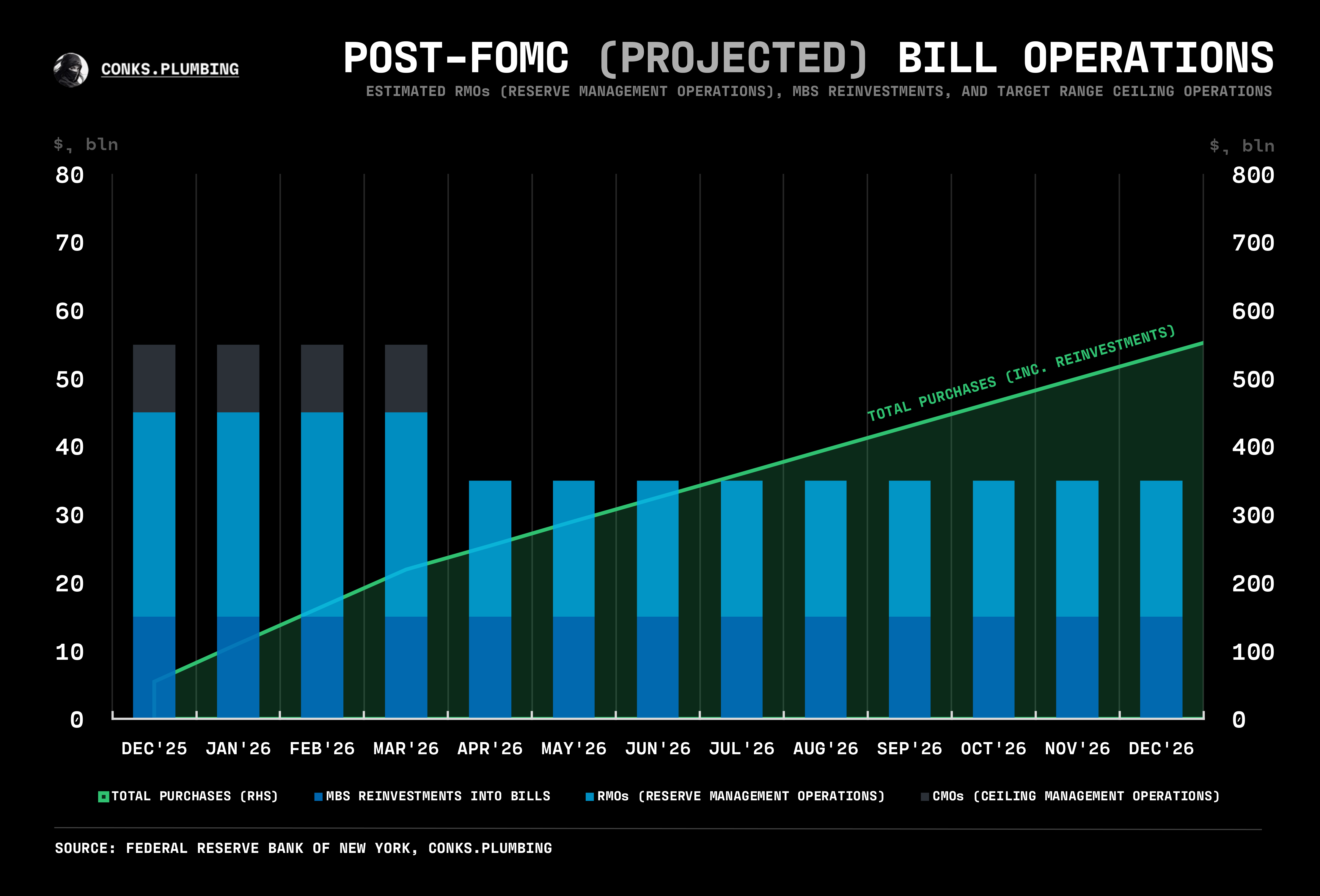
In a rare feat for an FOMC meeting, the plumbing has stolen the limelight from macro. The Fed has not only front-loaded cuts but now reserve injections, announcing a much-earlier-than-expected start to buying USTs (U.S. Treasuries) at the ultra-short end of the curve. QT and QE will be replaced as the most popular acronyms by “RMOs” and “CMOs”: reserve and ceiling1 management operations administered by the U.S. central bank, which involve swapping new reserves for bills in the secondary market2. Flying straight past temporary open market operations (TOMOs), such as lowering IORB (interest on reserve balances), officials have begun absorbing $40 billion a month in UST supply to subdue front-end pressures. With reserve levels about to force the overnight (o/n) rates complex to print well within the Fed’s target range, a Great Compression in money markets has commenced.
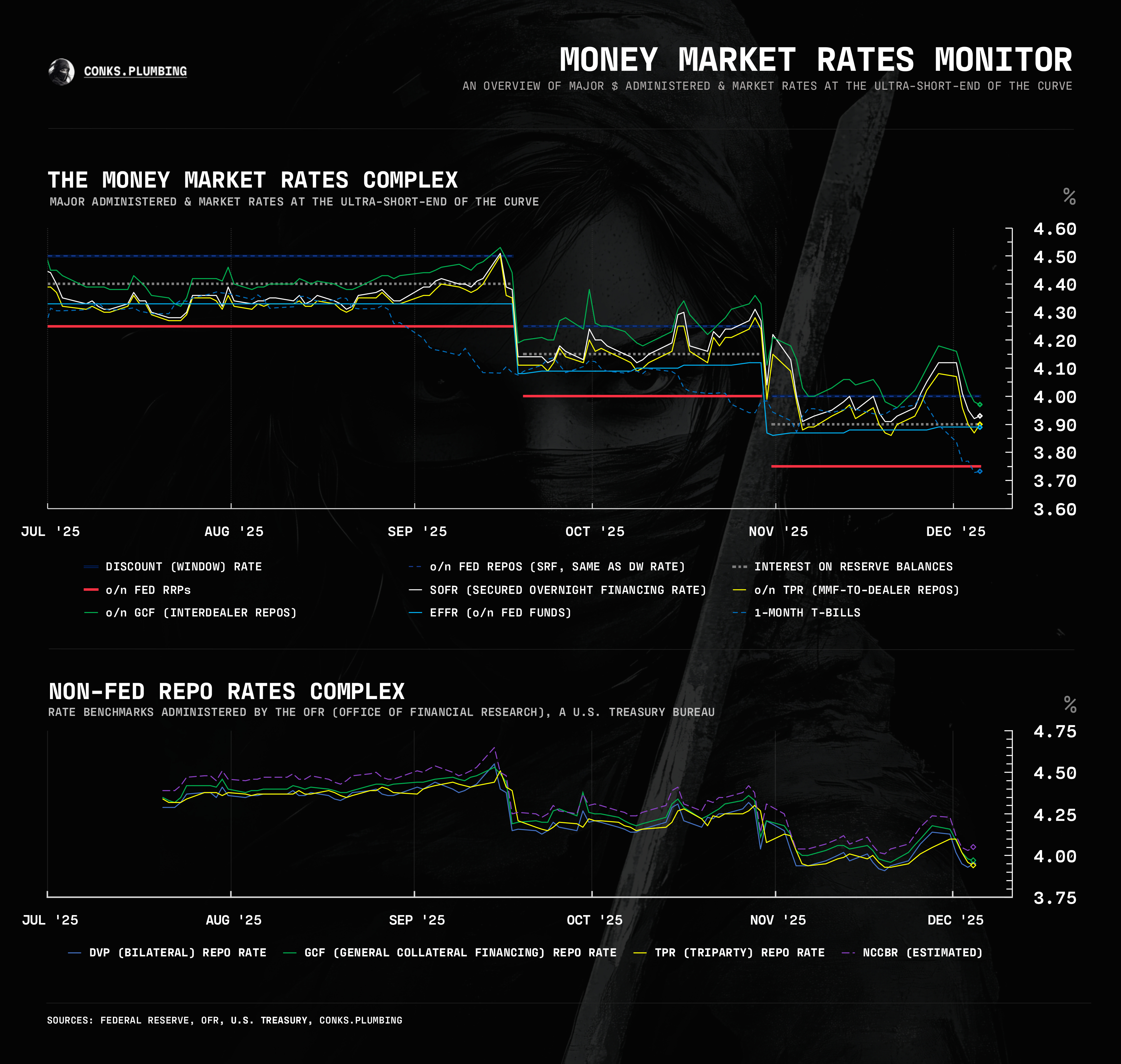
A swift return to near-abundant reserves is looming. Yet, the Fed’s post-QT asset purchases will be devoid of any meaningful easing outside money markets. Equities will need to rely on other forces to further climb the wall of worry. Rather than absorbing duration (i.e. interest rate) risk by buying longer-term USTs and slowly unwinding those purchases, the Fed is set to purchase short-term USTs3 to preserve waning interbank liquidity. As revealed by Chair Powell in the latest FOMC presser, officials will imminently deploy reserve injections to build up a cushion against several incoming “blindspots” arising from a volatile TGA4, the big risk centered around April’s infamous tax day5. Following this year’s interbank flows threatening to induce numerous blindspots, the Fed — now much closer to the system’s lowest comfortable level of reserves (LCLoR) — won’t take any chances.
Even so, the Fed should start pulling back on purchases, halting its reduction at around $20 billion per month. Over the long term, “casual” RMOs will help offset liquidity drained via forces other than a now-deceased QT program. Fresh reserves will replace those destroyed by currency creation and offset those hoarded by the Treasury, as it attempts to reach its potentially larger — up to $950 billion — cash target, and by foreign central banks parking dollars in o/n FRPs at the Fed’s foreign repo pool. All this while enabling banks to settle increased dollar flows as their balance sheets continue to expand. In the short term, by April tax day6, the Fed should phase out the “ceiling management” portion of its bill operations. With near-abundant reserves in effect, o/n rates will once again print on autopilot7 in their usual sweet spot, where SOFR prints below both SRFR (the Fed’s Standing Repo Facility Rate) and IORB.
The temporary increase in Fed bill purchases, roughly equal to Conks’ projections, removes any doubt that leaders desire rates to settle not just lower but well within their target band. Building a potential $160 billion buffer8 by the end of Q1‘269 to offset volatile TGA inflows from tax day seems overkill. $40 billion a month makes sense if the Fed were simultaneously attempting to implement a stronger, more effective lid on the o/n rates complex, enforced via reserve levels — teetering on the edge — of what most models deem abundant. This was nothing less than a U.S. central-bank assault on outstanding risks at the ultra-short end.
Nevertheless, based on pre-December FOMC action, participants were conditioned to expect a total snooze, something akin to the Fed implementing a perpetual ~$20 billion in RMOs starting early next year. Instead, they witnessed the start of a great compression in o/n rates. The Fed’s surprise frontloading of UST purchases prompted a volatile market response, so fierce that it has forced trading desks to dramatically reevaluate their outlook. With the Fed pledging to buy bills at — presumably — its max size and right out of the gate, the entire SOFR-FF curve has shifted into single digits, a move that will persist post-FOMC.
Even short-end swap spreads — Conks’ simplified gauge for plumbing conditions — rallied immensely, pricing in even more10 reduced frictions for short-term USTs11.
The market reaction was hallmarked by the sharp narrowing of the SOFR-FF basis curve, especially at this year-end (i.e. Dec SOFR-FF12). The sudden narrowing of Dec SOFR-FF showed just how out of the consensus Conks’ proposal for a December start to Fed RMOs had grown. Fast forward to today, a calmer finale to 2025 awaits. Year-end, as mentioned in Swifter Injections, should remain volatile. But rates will clear close to or within the Fed’s upper jaw. Banks will be better positioned to bridge imbalances. Canadian banks without a year-end will step in first, and the Fed, via swap lines, will step in last, neutralizing any global dollar imbalances when nobody else can or will.
Into the new year, trades relying on the narrowing in SOFR-FF bases — i.e. SERFF longs — won’t be threatened too much by a falling overnight Fed Funds rate (o/n FF). The delayed nature of the Fed Funds market should keep interbank rates (EFFR and OBFR) elevated for longer than SOFR. The biggest mispricings, meanwhile, lie elsewhere: in predicting when the Fed will start reducing its hefty bill operations. Views on when the Fed will deploy RMOs shall momentarily be replaced with those forecasting the timing of reduced bill purchases from the Fed. Consensus Great Compression trades have yet to emerge, but with the Fed providing uncertainty through oversized operations, opportunities will abound.
The Fed’s frontloading of bill purchases has likewise eliminated the need for the central bank to rush the fortification of its SRF. As rates should remain under SRFR, the o/n Fed repo facility will have less impact going forward.
Ironically, in a surprise announcement parallel to the December FOMC meeting, the New York Fed has made its next move to reduce stigma. Heads of monetary U.S. state, following a semi-covert meeting, have transformed the SRF into a “fixed price, full allotment” facility, eliminating the $500 billion auction limit while establishing a constant o/n lending rate. Competitive SRF auctions are dead, replaced by the Fed providing repo cash — up to $40 billion per security type per operation — at a single “divine” rate, set to the now-former SRF “minimum bid”. Conks’ SRFR (the Standing Repo Facility Rate) has a new true-to-life meaning.
Monetary leaders have thus executed a plan similar to Conks’ ideal approach to achieve a soft landing. We recommended the Fed start RMOs as soon as December, just not in such large amounts. Without the ability to remove duration and the need to sample the SRF further, commencing injections before year-end seemed reasonable. This, combined with testing term repos over the turn, would have been the optimal QT “exit strategy”. Yet, the Fed has missed its prime opportunity to trial-run term repos, a potentially effective way to reduce the spread at which dealers tap the SRF.
The small but mighty takeaway from the New York Fed’s sudden modifications is that it reinforces the idea that monetary authorities have grown tired of o/n rates printing beyond their prescribed boundaries. Numerous repo fortifications, paired with oversized bill operations, reveal officials in the short and long term won’t rest until they impose a significant cap on SOFR. The excitement around money market volatility is consequently over. Presently, only one volatile event remains: year-end. The Fed’s RMOs and CMOs, however, are about to ruin any major fireworks.
If you enjoyed this, hit the ♡ button below the footnotes to let us know (it helps us grow) and share a link/message on social media. Comments are also encouraged. Thanks for being a Conks Subscriber!
More Plumbing Notes
Join the Conks feed (chat):
In today’s Pro: the SOFR-FF (SERFF) spread to watch, RMO and SRF color, and more…
Chartbook (15th December 2025)
Changelog: N/A
WIP: STIR monitor, Treasury monitor, money market volume monitor
If you act on anything provided in this newsletter, you agree to the terms in this disclaimer. Everything in this newsletter is for educational and entertainment purposes only and NOT investment advice. Nothing in this newsletter is an offer to sell or to buy any security. The author is not responsible for any financial loss you may incur by acting on any information provided in this newsletter. Before making any investment decisions, talk to a financial advisor.
EFFR, OBFR, SOFR, TGCR, and BGCR are subject to the Terms of Use posted at newyorkfed.org. The New York Fed is not responsible for publication of tri-party data from the Bank of New York Mellon (BNYM) or GCF Repo/Delivery-versus-Payment (DVP) repo data via DTCC Solutions LLC (“Solutions”), an affiliate of The Depository Trust & Clearing Corporation, & OFR, does not sanction or endorse any particular republication, and has no liability for your use.
the ceiling (upper limit) of the target range
not debt monetization or fiscal dominance
bills greater than one-month in maturity and, if required, 4-year notes or less to maturity
the Treasury General Account (TGA), the U.S. government’s bank account, which is stored inside the Federal Reserve System
corporate tax payments pull reserves from banks and convert them into TGA balances (until the government spends that money, which re-adds these neutralized reserves)
on April 15th, corporations settle tax payments (through banks and the TGA) with the U.S. government
ex-reporting dates like month-end
assuming ~$40 billion a month in bill purchases until lowering that amount after March‘26
March 31st
this occurred alongside an equity rally, most likely a response to rate cuts rather than to bill purchases
the expected average difference between SOFR and EFFR this December


♥️